
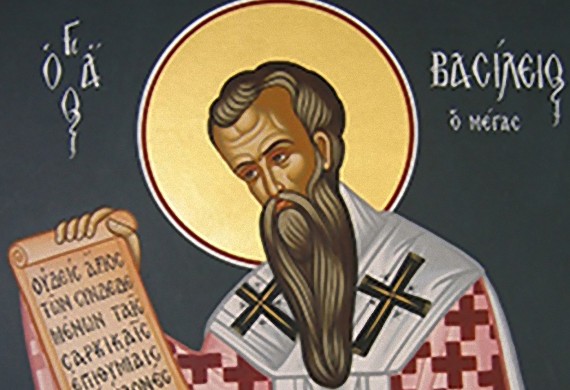
 Yesterday we celebrated our Holy Father among the saints, Basil the Great, and great he is! His wisdom and virtuous life are a wonderful testament to what a Christian is capable of if he abandons himself completely to God.
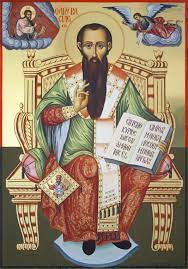
In Greece St. Basil’s feast day coincides with the traditional day of gift-giving. (Now a days, thanks to globalism, this has transferred to Christmas day in most Greek homes). Hence the confusion of thinking Santa Claus is “Agios Basilis,” St. Basil. Greeks have, unfortunately, embraced modern Santa Claus, but think of him as a modern version of St. Basil, instead of a modern version of St. Nicolas. So, two saints are dishonoured by modern, commercial Santa Claus. In an attempt to encourage children (and adults) to remember the true likeness of St. Basil, ie. not as an overweight “Coke-a-Cola” Santa Claus, Uncut Mountain Supply put out this icon. 
In Greece the tradition of cutting the vasilopita is kept. You can buy vasilopita (Basil-pita literally, but more like cake) from just about anywhere here in Greece. It is shaped in a circle and some (like ours pictured) have a XΠ on it for Χρόνια Πολλά (many years) as well as the year, since St. Basil’s feast day coincides with the new secular year.
Before cutting the vasilopita we first pray St. Basil’s apolytikion, and then we cross the ‘pita’ with a knife three times saying, “In the Name of the Father, the Son, and the Holy Spirit” and “Through the prayers of St. Basil the Great”. Then we cut the first piece for Christ, the second for Panagia (the Mother of God), and the third for St. Basil. The rest are for the number of people present. This year we also cut one for St. Anthony the Great (patron of our parish) and St. Nektarios of Pentopolis (because we love him) since we were only four people and the ‘pita’ was large. Fr. John (my husband) found the “foulouri,” the coin, in his piece. It’s a blessing.
Below is the most popular carol sung in Thessaloniki in St. Basil’s honour on New Year’s Eve. I’m not sure if it’s the most popular everywhere, but it sure is here. You can hear a version of it here – not the best, but the best I could find. There are many versions of this carol, the one below was translated by Holy Protection Monastery in Rhodes. You can visit their blog here.
 There is a tradition that says that St. Basil chooses to stay at someone’s house the night before his feast, someone with a pure heart. So, it’s not uncommon (at least in the past) to set a place for St. Basil at one’s dinner table on New Year’s Eve in hopes of him visiting you. Also, there’s a sweet story, retold by Fotis Kontoglou, called “Blessed John” about St. Basil’s choice to stay with a poor family one year. If I can find it I’ll post it.
St. Basil comes and passes by
He overlooks us, I know not why
He comes from Caesara Town
Mistress bring, mistress, bring, mistress, bring us something down
He carries pen and paper white
And sugar candies, sweet and bright
He brings his pen and ink for writing
You should see, you should see, you should see me in the fighting
The pen, it jumped up with one bound
And on the paper scribbled round
And then the paper started speaking
Yes, we swear, yes, we swear that the paper started speaking
The paper said, “Tis New Year’s Eve!
Oh, Mistress fair, I beg your leave;
Joy be your lot the whole year round
May your house, may your house, may your house be holy ground!”
“The New Year follows on Christ’s birth
So holy Christ who walks the earth
May bless you, every girl and boy
And fill all, and fill all—and fill all your hearts with joy!”
may we have St. Basil’s blessing!