
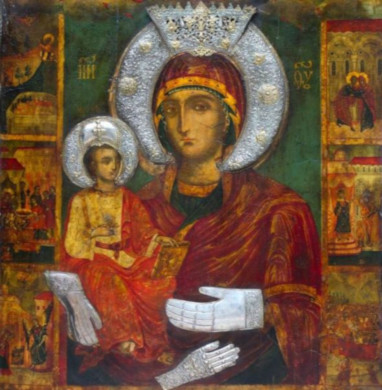
This image is the one to which Saint John of Damascus (celebrated December 4) resorted with justifiable complaint and prostrated himself, holding his severed right hand, with which he wrote the words in favor of the Holy Icons and which was cut off from him by the machinations of the iconoclasts. The Virgin Mary performed a miracle by reattaching and reviving the dead hand of her servant, and he dedicated a silver offering in the shape of a hand to her, which, due to its placement in the icon, makes it appear as a third hand of the Virgin Mary. The icon, which until the 12th century AD was kept in the Lavra of Saint Sabbas, was donated to Saint Sabbas, Archbishop of Serbia (celebrated January 14) and founder of the Hilandar Monastery, during his visit to the Holy Land. He brought it to Serbia, from where it was later miraculously transferred to Mount Athos, when during the internal turmoil that occurred in Serbia under King Uroš V, the mule that always carried it before the army in various battles was lost and, proceeding on its own, reached Hilandar at Mount Athos peninsula. In a later period, when discord arose within the brotherhood of the Hilandar Monastery due to the election of a new abbot, the Three-Handed Virgin miraculously moved from the Holy Altar, where she had been until then, to the abbot’s seat. At the same time, a virtuous hermit monk informed the brotherhood that henceforth, to avoid disputes, no abbot should be elected at Hilandar, because the Virgin Mary would hold this position and govern the monastery. Indeed, to this day, the Hilandar Monastery Brotherhood, while living communally, is without an Abbot and is governed according to the system of idiorrhythmic monasteries.
From the Lives of Saints
Trancelation by Dr.
Nick Stergiou


