
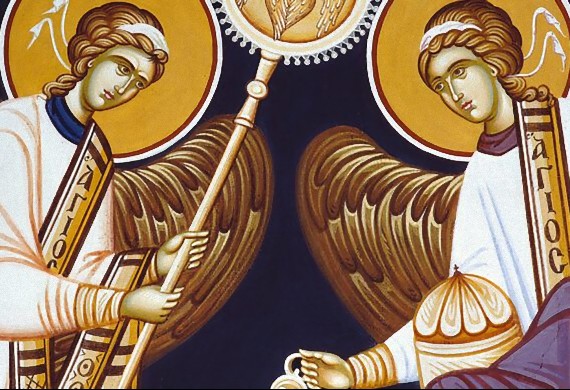
The Holy Bible and Sacred Tradition host numerous testimonies regarding the existence and actions of angels. After the fall of the first humans, angels guard Paradise, angels teach Adam how to cultivate the land, while angels appear to Abraham, Lot, during the Exodus of the Israelites from Egypt, and to many of the prophets. In the text of the New Testament, angels are mentioned in many passages, the most notable of which are during the Annunciation to the Theotokos and throughout the life of Jesus from His Birth to His Ascension. Angels were created before the material world, as in the book of the Old Testament. In “Job,” God is depicted as speaking and confessing that as soon as He created the stars, all the angels praised Him with hymns.
While St. Basil the Great also mentions that before the creation of the material world, there was an eternal and older state, which is the world of angels. The manner in which they were created by God is not known to us. However, we can get an idea of this from the teaching of Saint Gregory the Theologian, who says that the angelic powers were created as soon as God conceived the idea of their creation. That is, God’s decision to create the angelic world also meant its simultaneous creation. The purpose of the creation of angels has nothing to do with any need of God. It is not possible for the material or even the spiritual world to offer anything additional to the glory of God. The purpose of the creation of angels is revealed by Saint John Chrysostom, who says that God gave them existence and life for their own sake, motivated by His “ecstatic” love and goodness, and with the aim of sharing His blessedness as rational beings. They partake in the Divine beatitude and are nourished by the continuous vision of the face of God. However, this participation in divine beatitude drives the angelic beings on a continuous upward path, a path toward spiritual perfection. Saint John of Damascus, attempting to provide a definition of angels, says that they are rational natures, ever-moving, self-determined, incorporeal. They serve God and are by grace immortal. The nature of angels is spiritual. However, since only God is considered absolutely incorporeal and immaterial, the angelic body is therefore considered etheric, fiery, extremely swift, and much finer than the matter we know. Angels, in terms of disposition, are free and mutable, having the ability to advance toward good, but also to turn toward evil. The intelligible powers possess, according to Saint Gregory Palamas, mind and reason, but without a “life-giving spirit” because they do not have a body. Therefore, they do not acquire divine knowledge through the senses or through the analysis of thoughts, but by remaining pure from any material element, they perceive the intelligible in a mental and incorporeal manner. Despite the purity and simplicity of the angelic nature, angels are susceptible to evil. Thus, they can choose the continuous advancement in the higher Knowledge and the communion of Love or the denial of this Goodness. The result of their freedom is also the fall of the order of Lucifer. This angelic order was not content with its marvelous brilliance, rejected the hierarchical progression of divine knowledge, and desired its complete and immediate assimilation with God. For this reason, it willingly succumbed to evil, deprived of the true life, which only it (the order of demons) denied. In this way, they became dead spirits since they expelled true life and do not feel remorse from their impulse toward evil, constantly adding vilely to the already existing evil. However, the angels who did not follow Lucifer in his rebellion acquired the gift of perfect immutability and immobility toward evil. This happened with the Incarnation, the crucifixion, and the resurrection of Christ, as they learned that the path leading to the likeness of God is not pride, but humility. The immobility of angels toward evil does not mean that their free will disappears, but that it is sanctified by the grace of the Holy Spirit. Angels have greater and superior cognitive abilities than humans. Of course, they are neither omniscient nor omnipotent like God. They do not foresee the future, except if God reveals it to them, nor do they know what exactly is hidden in the heart of each person. They do not know when the end of the world and the Second Coming of Christ will occur. Their movement is extremely fast, but they are not omnipresent. Every time they are in a specific place, without knowing what is happening elsewhere. They do not have a gender, because their nature is spiritual, and they do not need food to live, or rest to recuperate, nor do they die or multiply. Their immortality does not stem from their nature, but because they participate “by grace” in the holiness of God. The number of angelic beings is incalculable and immeasurable. Christ himself speaks in Gethsemane of more than twelve legions of angels, while the Evangelist John testifies that he saw and heard around the Divine throne a choir of myriads of myriads and thousands of thousands of angels. All these countless angels are organized into legions or, in other words, into ranks. Gathering the references on this subject from the Prophet Isaiah, the Prophet Ezekiel, the Apostle Paul, Saint Dionysius the Areopagite, and Saint Niketas Stithatos, we can conclude the following:
The orders of angels are nine, which are classified into three triads of hierarchies or brigades, as follows: Seraphim, Cherubim, Thrones – Dominions, Virtues, Powers – Authorities, Archangels, Angels. The characteristic of the first hierarchy is fiery wisdom and the knowledge of the heavenly, while their work is the theophoric hymn of “gel.” The second hierarchy has as its characteristic the arrangement of great matters and the performance of miracles, while their work is the thrice-holy hymn “Holy, Holy, Holy.” Finally, the characteristic of the third hierarchy is to perform divine services, and their work consists of the hymn “Hallelujah.” Beyond the names of the nine orders, the Holy Scripture also reveals to us the personal names of certain angels. We know Gabriel, which means “hero of God,” from his appearance to the prophet Daniel, the prophet Zechariah, and the Theotokos. We know Michael, which means “who is like our God,” as he appears many times in the Old Testament. Raphael is the third angel we know, his name means “the Lord heals” and he appears in Tobit, carrying human prayers to the throne of God. Finally, known from Jewish tradition is also Uriel. Angels perform a threefold work. First and foremost, they ceaselessly glorify God. This glorification has not been imposed on them as a command, but it is completely spontaneous, arising from within themselves, when they behold the beauty of the Divine person and the grandeur of His creation. On the night of Christmas, for example, a multitude of heavenly hosts appeared, praising God for the event of the divine incarnation.
Their second work is the ministry in the Divine Economy. They feel such love and gratitude toward their Creator and a strong desire for their own progress, that they serve the mysteries of Divine Economy. The angelic orders hierarchically transmit enlightenment and knowledge to one another. The revelations of God are taught by the higher orders to the lower ones, and when God allows a mystery to be revealed to the mind of a holy person, it will happen hierarchically. The third work of the angelic powers concerns the salvation of humanity. With this, they were entrusted after the creation of man and they carry it out with particular willingness and joy, since every time a person repents for their sins, they celebrate and rejoice in heaven. In the ancient work “The Shepherd” by Hermas, there is mention of the personal guardian angel of each person. He is indeed tender, modest, gentle, and teaches the human heart justice and the path to goodness. And other fathers of our church teach that the necessary condition for the guardian angel to remain beside a person is a holy life; otherwise, he departs due to wicked and sinful deeds. This angel comforts in sorrows, helps in pains, sympathizes with the person, guides them to repentance, and protects them from visible and invisible enemies. However, apart from the guardian angel of each person, there are also the guardian angels of nations, cities, and local churches. In the Old Testament, in the book of Deuteronomy, God distributes the nations and sets the boundaries of the nations according to the number of His angels. Then Saint John Chrysostom observes that God has stationed camps of angels in every city to thwart the attacks of demons. Finally, Saint Hippolytus is particularly clear when he compares the church to a ship with angels as its sailors. The Orthodox Church has always honored the angels. Their honorable veneration was officially proclaimed by the Seventh Ecumenical Council in contrast to the worship that pertains only to the person of God. In the weekly liturgical cycle of services, Monday is dedicated to the angelic powers. Two supplicatory canons concern the guardian angel and the heavenly Powers. The annual liturgical cycle is marked by six feasts dedicated to the angelic world, with the most prominent being that of November 8th, during which the gathering of angels under the archangel Michael is celebrated as a resistance against the apostasy of Lucifer.
But the primary honor of the angels is given in the Divine Liturgy. There, the people of God on earth and the heavenly hosts, with one voice, in a common liturgical assembly, offer praise to God. Together with the priests, they gather at the altar and co-celebrate the divine goodness. Together they encircle the holy Table and the precious gifts, through the hand of an angel, they are offered as a fragrant spiritual aroma at the heavenly and noetic altar. However, those who particularly honor the angels are the monks. Through their constant prayer and superhuman asceticism, they strive to resemble the angels and to replace the fallen order of demons. That is why the monastic tonsure ceremony is called: “The Rite of the Great and Angelic Schema.”
Archimandrite Ioannis
Prof. Dr. Nikolaos Stergiou
Assistant Dean and Director of the Division of Biomechanics and Research Development, University of Nebraska at Omaha
The World of Angels